

CINCINNATI (TDB) -- All that remain of the hardwood trees that graced the Madison Road esplanade in the heart of Oakley are stumps in the ground. They'll be ground to sawdust soon. Amy Teitelman wonders what kind of government-funded beautification project sacrifices beautiful trees. She's written an open letter to Cincinnati officials on Triple Witching Hour and sees waste and devastation: "Now I look out the window and see a scene from fucking Lorax."
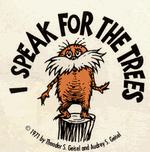
The Lorax is a Dr. Seuss story about a creature who works to save trees and does battle with loggers, or despoilers. Here's some of Amy's letter to the City of Cincinnati:
"Here's what I can't forgive: you just cut down the beautiful old trees in the esplanade on Madison Road. Cut most of them down, and lopped the branches off the rest, leaving four or five amputee trees standing pathetically among their fallen neighbors. (Are you going to at least put them out of their misery?) Last October, I looked out my dining room window at a just-married couple getting some pictures taken under those trees before heading into their reception at the 20th Century Theatre. Little kids were taking the fallen leaves and throwing them into the air around the couple for some of the shots. If I were the sort of person who used the word 'heartwarming,' that's how I would describe the moment. But now? Well, now I look out the window and see a scene from the fucking Lorax.I understand that this is an ARRA [American Reinvestment and Recovery Act] project and I support reinvestment and recovery and good jobs. I understand that you are using 'green' technology and there will be some sort of rain garden, which is dandy - but can it possibly make up for all the fossil fuels you are burning and materials you are using and TREES YOU ARE CUTTING DOWN? I understand it will look pretty, but didn't it look pretty before?"
Yes, it did look pretty before. And Amy has another excellent question: Why was Oakley, one of Cincinnati's economically healthier neighborhoods on the East Side, targeted for beautification? She's says there are other Cincinnati neighborhoods that are shabbier and would benefit from a sprucing up. And yes, she's right about that, too.
The Lorax is a Dr. Seuss story about a creature who works to save trees and does battle with loggers, or despoilers. Here's some of Amy's letter to the City of Cincinnati:
"Here's what I can't forgive: you just cut down the beautiful old trees in the esplanade on Madison Road. Cut most of them down, and lopped the branches off the rest, leaving four or five amputee trees standing pathetically among their fallen neighbors. (Are you going to at least put them out of their misery?) Last October, I looked out my dining room window at a just-married couple getting some pictures taken under those trees before heading into their reception at the 20th Century Theatre. Little kids were taking the fallen leaves and throwing them into the air around the couple for some of the shots. If I were the sort of person who used the word 'heartwarming,' that's how I would describe the moment. But now? Well, now I look out the window and see a scene from the fucking Lorax.I understand that this is an ARRA [American Reinvestment and Recovery Act] project and I support reinvestment and recovery and good jobs. I understand that you are using 'green' technology and there will be some sort of rain garden, which is dandy - but can it possibly make up for all the fossil fuels you are burning and materials you are using and TREES YOU ARE CUTTING DOWN? I understand it will look pretty, but didn't it look pretty before?"
Yes, it did look pretty before. And Amy has another excellent question: Why was Oakley, one of Cincinnati's economically healthier neighborhoods on the East Side, targeted for beautification? She's says there are other Cincinnati neighborhoods that are shabbier and would benefit from a sprucing up. And yes, she's right about that, too.

